Showing posts with label Philosophy. Show all posts

Monday, April 11, 2022

Callings

When I was young, I thought I had one Calling, one enduring vocation or purpose in life. Lately, I've come to realize that it might be more of a hierarchy of Callings, and that like everything else in the universe, these Callings and their relationships are dynamic. As Mrs. Judy Berry told us repeatedly in Chemistry class, the only constant is change. Certainly, the way I have learned to listen to God/ the Universe's callings has changed. The tools I have acquired to serve these Callings have also definitely changed as a result of my education and experience. 

In fact, I have reached a pain point. I hear Conflicting Callings. Sometimes even contrasting Callings, like Art and Science. And so many Callings that I cannot serve them all, or even a few, well at once. How do you decide what calling to serve when all are noble and necessary? When all help you remember the joys and miracle of all creation? When all are open to you and require roughly the same amount of work and resources to pursue (i.e. there is no one obviously expeditious pick)?

In high school, I knew I wanted to help. "Helping" was my calling. Specifically, I wanted to help people process their emotions and find meaning in their lives. Mainly I considered two possible careers, one as a writer, or one in psychology. Eventually, I decided that I could be a writer with any education, but I could not be a psychologist without degrees in psychology.  I also thought it likely that learning psychology would make me a better writer (with a better understanding of characters' motivations). This realization solved the painful need to make decisions about what to do after graduation. Granted I still had to make many decisions along the way...like would I be of best helps to others in finding meaning in life as a Clinical, Counseling, or Industrial-Organizational Psychologist? Could I serve well enough with a master's or did I need a doctorate? And the questions have never really ended. Should I work as a research scientist or as an applied scientist-practitioner? As an internal or external consultant? For a non-profit providing a critical service or for a private corporation employing hundreds of thousands providing infrastructure? What about teaching too, just adults on the job or higher education as well? Where is the sweet spot of greatest need fitted to my particular greatest strengths?

I was always looking for that one, sweet spot. The Calling...and maybe that is the problem. Maybe there is one big Calling factor with dimensions and sub-factors, just like we have a personality with 5 dimensions (OCEAN) that can be interpreted into 16+ further sub-factors (https://en.wikipedia.org/wiki/Personality)? Maybe my main Calling is simply, "to help others find meaning in life" and there are dimensions I must shift my attention to over the course of my life like writing, psychology, art, love, caretaking, etc. And even among those dimensions, there are sub-factors, like poetry, fiction, research articles, and textbooks under the dimension for writing. I couldn't stop myself from writing poetry in my first 30 years of life, but after that, I longed to write books. Every dimension has competing sub-factors like that for me. When asked what I want the next five or ten years of my life to look like now (compared to being asked this question a decade ago)...I have a very difficult time answering. Now I want my life in ten years to look like everything. I want to be the old lady in argyle socks with a chicken and two cats in the front basket of her bicycle peddling to the farmer's market to sell paintings on Saturday who does yoga and a cooking class with kids on Sunday, who coaches the executive board of the SPCA on Monday, runs a teamwork simulation for firefighters on Tuesday, writes a romance the rest of the week, and then leaves to present Grand Rounds at a hospital in Auckland and hike in New Zealand on Friday. It's impossible.

Or is it? It's certainly impossible to achieve so many outcomes. But what if I let go of the outcomes? What if I let go of the timetable? What if I just think about the doing, the dimensions themselves, instead of what doing them looks like or achieves? What if I just make sure I am doing something in every dimension of my Calling? I can do art, do writing, do psychology, do love, etc. That is possible. Maybe I won't "achieve" much in any one dimension, but is that really the point? What if the point is simply that I help myself find joy and meaning in life? What if that helps others do so too? Just that. 

Lately, I think the Calling, sounds like it is telling me to serve as a polymath. A polymath is traditionally thought to mean a "renaissance man," who has mastered many talents, and we picture someone like Leonardo DaVinci. I'm no Leo. But the dictionary definition of a polymath isn't about talents or outcomes. The dictionary definition of a polymath is "a person of wide-ranging learning." When I am widely active, open to and learning everything, I am happiest. I find life has great meaning for me the more widely I learn. I gain a wealth of experiences...even when I accomplish very little. In turn, that wealth of experience makes it easier for me to listen to and understand what others are sharing more fully. I become someone who understands others well, I become more equipped to help others...and maybe that is the biggest, most helpful calling I could possibly serve anyway? Is there anything more needed than someone who helps others feel heard and understood? That sounds like a grand Calling to me.

Maybe the sweet spot isn't where my interests in writing, psychology, art, love, etc. all coalesce to serve in the greatest possible way to help people. The sweet spot could be doing all of these things in ways that bring me a great balance of joy and learning. If I enjoy the learning, I will learn more. If I learn such a wide variety of things, I can understand and share in more ways all the things that bring others more meaningful lives. I have no doubt that a deep connection to purpose is important, but I think I  hyper-focused on depth for a while. 

The universe is deep and broad, and to paraphrase many religions, "I am nothing. I am everything. I am the universe." We are all made of the same stuff. The signal I hear now says be broad and deep.

I am writing, consulting, teaching, and braving another dimension now too: creating art. I've always doodled, and I've been into photography since 1992...these arts were a way for me to notice and honor the existing beauty in the world. A hobby. I started sharing #RandomEverydayBeauty photos on Facebook in 2005...I felt a calling to share the glimpses of beauty I noticed in case others needed them too. In 2018 I felt a tug to try drawing for Inktober: a commitment to doodle one thing a day in ink for 31 days. The act of drawing centered me. For a few minutes each day, I didn't think about anything except observing and creating. I've done Inktober every year since then, but in 2021 something special happened. Another polymath professor asked me to join a faculty, staff, and student art club online so we could share Inktober efforts and inspirations. The sharing went so well, we made it go on beyond October. I started drawing something every week, even after October. I asked friends if they wanted a painting or drawing of anything just so I could stretch my skills on new subjects. Friends offered birds, pets, landscapes, loved ones, random ideas (...I'm looking at you fellow author who asked for a chicken smoking a cigarette) for me to paint. 

I decided to sell a few of these efforts on RedBubble.com so I could pay for more art supplies, so I could paint more, so I could learn more. More artists started sharing their art with me, inspiring new ideas, and helping me understand their motivations better. I became even wealthier in friends. And one gift I did not expect...I've found such joy in painting portraits of family, babies, and pets in ways that are meaningful for others. I just did it to practice at first, but lately, everyone I've done one for has mentioned something about how the painting allows them to represent their memories and the spirit of the subject better than their photos (that have stuff they don't want in the backgrounds or don't have all of the people they want in it together, etc.). I am answering a call to help that I didn't hear before today. I'm open to these calls now too. Van Gogh lost an ear, lived in an asylum broke and unknown, but loved art enough to just do lots of it every day anyway... it could be that he knew learning in this dimension was worth everything for him at that moment? Van Gogh only sold one painting while he was alive, for 400 francs (roughly worth $4,000 today), seven months before his death. He never knew any of the outcomes like how many millions of people would study and love his art because it helped them see the world's beauty. I take it as a lesson...I may not know how I'm helping, but I can't help at all if I don't answer the Callings, listen to their dimensions and reply to whatever sub-factors come up.
https://laceysarts.com/

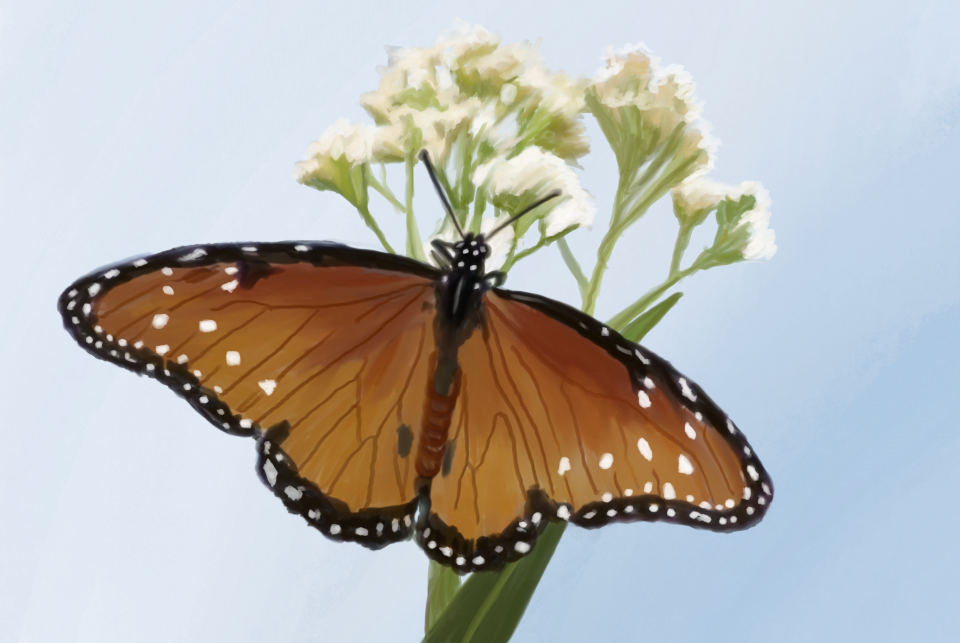
This is my painting of a Queen Butterfly serving its "Calling" as a pollinator.


Saturday, April 18, 2020

The COVID Diaries: Can I Graduate?

I write this to all graduates this year, but especially those who have slaved an extra eight to twelve years earning a doctoral degree. I have empathy for the effort and struggle you have endured. As my former study-buddy (a Marine NCO) used to say, "It's like getting F*cked up the @ss with a corncob and having to say thank you for the privilege." Especially if school didn't come easy for you, or you paid your own way one class at a time, or if you're somehow a first in your family and had to navigate the social path (and all those strange new terms and rules) on your own.
You were likely looking forward to skipping across the stage in some seriously hotter-than-sin formal regalia, complete with an unflattering hat of Cambridge or Oxford design. Some of you skipped walking for your undergrad degrees and master's degrees, saving money and family travel for the big one...the one that really matters...the last one you planned to do. I hope you all still get the pomp and circumstance in person someday, even if delayed. But even if you don't, I offer you my heartfelt congratulations and appreciation.
I also offer one bit of hard-won wisdom from my own strut across that stage in velvet. I thought that would be the day I finally felt it was done. I thought that would feel like a big victory. I was wrong. The surge of pride and a real feeling of victory and meaning to the struggle was NOT that day, or even the first day someone called me Doctor Schmidt, or even the first day I received my 1,000 new business cards with the Ph.D. on them, or even the day I got my first seriously real-doctor-job paycheck. Turns out the day that felt like graduation was really the day I first had to pull out all of those fancy new intellectual tools and use them to make lives better...something I was only able to do because I endured and persisted and kept practicing perfecting my learning well after the rented velvet robes were all returned. I think your big day is now to come because you were also brave and bold enough to persist in learning and now it's a bone-deep habit. Congratulations! You came, you learned, and you will soon conquer your first of many challenges in making the world work better. No matter how you celebrate it this year, allow yourself to feel the free fall into your most-amazing potential. Graduation is just a very brief welcome to the best adventure of your life. Dum vivimus vivamus, and God Speed!

Even without the monkey suit, you still win (maybe more so because you can pick your own ceremonial robes that you look cool in now).
*Note: The title of this post is borrowed from a Third-Eye Blind song, "Graduate." I used to sing it to myself a lot as I spent night after night running stats programs in SAS for my research (back when a comma out of place might mean another 4 hours to fix and rerun your analysis...Yes, I know I am old.).

Friday, January 31, 2020

X outliers unite!

I believe that generational typologies are about as prescriptive as horoscopes, and well, horoscopes take advantage of the Barnum Effect (click the link and look it up, you'll be better for it). As a consequence, I've never worried too much about the Generation X archetype I could be assigned to.

Academics have in turn argued that our generational experience has made us everything from apathetic slackers with tortured latchkey childhoods to silent and brilliant entrepreneurs who could save the world from braggadocious Boomers and credit-eager Millenials. The truth is all of that. In every generation, there are slackers and hard workers, apathy and action, hope and cynicism.

The only outlier about being among those born between 1965 and 1980, the only truly unique experience of our generation is that we have never at any point in our lifetime been the majority. There was always a generational population running society bigger than ours (either older or younger or both at once). Because of aging effects, we have also never yet been the minority generation (the oldest generation has always been the minority so far).

If there is anything unique about Gen X, it is that we don't know what it is like to be the majority or the minority. 


We know what it is like to perpetually be the middle kid--always in training, never in power, but responsible for everyone younger still. Middle management.  Not a hero, but not a victim either. All of the work, none of the credit, and none of the celebrated potential that goes along with being the young prodigies.

X marks the middle spot, an outlier by it's sheer perpetual, stuck in the middleness. 

My advice? (And you know I have some or I wouldn't be writing this.) Live it up, Gen X. No one really gives a shit what we think--let's use our outlier middleness to make that more a blessing of absolute freedom than a curse of our generational existence. As the middle kid, we can probably get away with some pretty outrageous peace deals. Let the Boomers borrow our Chuck Taylors, teach them how great it is to not wear pants to work and convince them it was their great idea all along. Mentor those millennials through having a meaningful career and finding work-life balance while knowing most of them will never be promoted or convincingly rewarded for their hard work. Remind Gen Z that reality TV started out as a documentary called "The Real World" and involved artists who couldn't make a living having to tolerate each other's cereal habits...every freaking morning, without a smartphone for distraction. We can show everyone what the middle is like...not knowing who you are or what you want, but usually knowing this isn't it. Whatever. Shrug. No one gives a shit!

Vive le milieu! It isn't mediocre, it's the only living extreme in generational existence right now. 

A reunion of X outliers.


US Census Bureau. (June 4, 2019). Resident population in the United States in 2017, by generation (in millions) [Graph]. In Statista. Retrieved January 31, 2020, from https://www.statista.com/statistics/797321/us-population-by-generation/ 

Friday, January 10, 2020

Do and hope?

One of my matriarchal family lines (Caldwell-Tatum) has a centuries-old family motto:
Do and hope. Fac Et Spera. 
A lot can be read into these three simple words, even without the fancy armored arm waving a sword through a crown crest that goes along with them. As a kid and then a young woman I was drawn to the words hope and do individually, and in that order. I pictured noble ancestors hoping for a better life for themselves, their family, their country and doing the work, adventuring, rebelling, immigrating, bootlegging, and learning to make those hopes happen. I took heart in my naive hopes of saving the world and dared to tilt at windmills and bang my head into brick walls of bureaucracy and apathy. I even rallied others at times vicariously with my off-gassing of hope and determination. Hoping and doing was initially a very satisfying mantra or motto, and then I discovered I had it backward.

I'm now arguably middle-aged and have suffered through obtaining three degrees and a host of traumatic experiences in extreme environments where I could literally do nothing and the worst outcome was hopelessly inevitable. As a consequence of my jobs, I necessarily do a lot of observing only (e.g. job analysis, teamwork assessment, organizational research, executive coaching). There was nothing I could do to prevent a detective from being shot to death during my ride-along or put life back into the many broken and defeated bodies I followed first responders to, or bring back an astronaut or faculty member I had worked with after a tragic incident, or to help a healthcare professional or veteran actually get past the repeating memory of a gruesome trauma. There was nothing I could do that had any hope of saving two of my best friends from a boat fire or my dog from drowning or my in-laws from a long, slow, scary cognitive decline, or young family members from being exploited and disparaged into self-destructive behaviors. There is certainly nothing I can do that has any obvious or immediate hope of stopping deadly wars, natural disasters, famines, greed, or ignorance. Living has made it abundantly clear that waiting on hope to inspire me to do is completely hopeless.

Hope feeds on the fumes of doing, not the other way around. Sitting in the bulletproof back of that police cruiser while one detective struggled to drag his partner out of the line of fire, I thought of things I could do to better select and train officers to survive and to support their families and colleagues when they did not. When the horror was over, I set about doing those things as much as possible and convincing others to pay attention to doing them too; and I found the hope to do more from there. I've learned that the doing must come first or my hope will certainly die. I must do in order to feed my future hope.

I still read a lot into those three words. I cling to them in their exact order now, do and hope. They save me from Post-Traumatic Stress Disorder. They remind me that if I wait to hope, I may never do what is really necessary or actually helpful again. I do the best I can to change what I can for the better while I can with what I have and hope that makes my own or someone else's adventure living a little easier or better from that point on. I do, and I make mistakes or sometimes I just end up doing the wrong thing, but then I do something else or something differently next time, knowing that I will probably learn something that has an even better hope of influencing lives. I write and hope it will speak to what someone else needs at some point in time when they most need it, but I do not wait until I feel hopeful someone would like to read it before I write it. I certainly do not wait to write until I have hopes of achieving success (whatever that is). I write and hope I can revise it to be even better later as I learn. I do, then I hope, and that is how my next day always dawns beautiful and clean and full of purpose now.


Do and hope.

Wednesday, June 20, 2018

Owning The Adventure


You will never believe
The things that I have seen,
Though, I could tell you a hundred stories
of

Days when everything
Is sacred
And pregnant
With hope.
Grass stands
Thick, cool, and green
Beside a burbling stream
On a Siberian slope.
Trees older than Jesus
Reach to the sky
Gnarled high,
Mid-Nevada miracles,
Stark clear and dry.
A mother,
A astronaut,
Reaches the stars
And shares the trip
So that more children
Dare the slip
From the surly bonds
Of gravity.
Free to see
Earth’s blue marble beaming.
Underpaid firefighters
Stop traffic
To rescue
Blossoming
Squirrel puppies.
All God’s creatures
Are small,
Are great--
Small on judging,
Big in faith.
And I believe
In everything.

Days when nothing
Is sacred
Nor born
With good will.
Rival owners
Firebomb strip clubs
Killing sex-traffic victims
And booming their business.
A trusted official
Commits the felony
And not only goes free,
But doesn’t have to flee,
And still gets re-elected,
While the Under-Represented Minority
Remains unduly suspected.
Fundamental attribution error
Breeds increasing cognitive bias
Like plastic pollutes the sea
And millions in apathy
Toss on billions of straws.
Camels aren’t just beaten
Bloody and raw
In fables of Shahs.
A Grandmother,
A hater,
Brutalizes a baby
Breaking bones zero to 206
Per angry shake,
But she gets to demand
The doctors finish
Killing the kid slowly
On life support.
And I believe
In nothing.

What does it mean to believe?
There once was a fork in the road…
I choose my own adventure.


There is never enough time to choose, and yet we must choose again and again each day.

Friday, June 30, 2017

Anthropo-Quality?

an·thro·po·cen·tric
ˌanTHrəpəˈsentrik/
adjective
  1. regarding humankind as the central or most important element of existence, especially as opposed to God or animals.

I believed humans were kindest,
able to put others lives before our own.
Until I saw a Mocking Bird attack
a Rattle Snake 
to save a Blue Jay's baby.

I believed humans were most playful,
socially animating objects to share laughs.
Until I saw a Lamb and a Blue Healer 
play Soccer
with a volleyball.

I believed humans were most eloquent,
creating new language to represent ideas.
Until I saw a Gorilla
signing "water-bird"
to explain a Swan.

I believed humans were most creative,
fashioning art and tools that solve problems.
Until I saw an Elephant
use rocks to build a step-stool
for an undersized calf.

I believed humans were wisest,
mindful of goals and masters of plans.
Until I saw Gibbons 
sort cards in patterns
to obtain a prize
and Magpies adapt 
caching
for contingency hints.

I believed humans were most complex,
synthesizing sciences to birth robotics.
Until I saw ancient Aspens
cloning colonies
via Rhizomatic roots and nodes.

Now
I suspect
my Grandparents were correct,
in that all creatures,
great and small,
live of central importance,
if not singular intelligence.

Now 
I believe
all molecules matter.
All beings created to function,
qualities always evolving
into more beautiful forms
the universe requires. 
Maybe reptiles write poetry too and we'll learn how to hear it one day.

Thursday, June 1, 2017

Yea, Verily

The world is going to hell in a hand-basket,
Rolling like a stone with no moss toward the crack-ass of doom.
Because of those lily-livered, over-educated, snowflake liberals?
Because of those myopic, misanthropic, red-neck conservatives?
Because of all the apathetic insufficiently engaged ditzes in-between?
Maybe.
But more likely,
We'll wipe out the human race,
Yea, verily and pass the peons please,
Because of our self-fulfilling prophecy,
Of a world whirling toward gloom.
Yea, verily and pass the pity please,
Because we are convinced,
the problem is too big, spread and deep,
For one person to make a difference
And that making a difference means
Convincing others to see things
From our point of view.
Yea, verily and pass the prejudice please,
Because we don't realize,
Making a difference should mean
Understanding others well enough
To make them secure enough
To find the rare courage required
To do their own internal reflection
Without caving to cognitive bias,
Or debasing in debates over what is fact.
Or I could change course,
Yea, verily and pass the peace please,
I may be any one
of my brothers and sisters
only keepers.
So Yea, verily,
I will own my responsibility
To ask,
"How are you today
And why?"

Friday, May 19, 2017

The Human Recipe


Directions:
1. First, start with the First Law of Thermodynamics since energy is conserved and can neither be created nor destroyed. Mix one part light, one part heat from common sources of decay (e.g. earth, dung, clay, ancestors' ashes, masticated chloroplasts, etc.)
2. Begin kneading the soul, the essence or embodiment of organized energy until photon pair production coalesces into a visible matter and cells begin to shape.
3. Infuse resulting Mitochondrial structures within cells to convert the energy from food into a form that cells can use because there is going to be a lot of replicating. Wait until replication results in egg and sperm cell.
4. Preheat and line a willing womb before gently folding together egg and sperm cells.
5. Embed the fertilized egg into lining of the prepared womb and gestate for approximately 37 to 42 weeks or until aura is golden fresh.
6. Plate Being upon arrival and nurture neural development to keep warm.
7. Finally, garnish with love for a lifetime and serve with a side of entropy to induce recycling.
*Note: Recipe yields ten-fold the expected servings of hubris and hope.
Golden light casts a deep human shadow.

Sunday, January 29, 2017

Our 1st Refugee

In 1680, a Huguenot named Sara Jans Noe fled a town in France where she'd been branded a terrorist and 75% of her village had been killed for their religion and the crimes against the crown that religion perpetrated.
My 6X great grandmother took refuge in what would become New York, thanks in part to the efforts of her grandchildren (some more terrorists), who fought against the British and served their adopted communities' efforts to establish the United States of America.
Over the next 337 years, some of Sara the Refugee's progeny committed crimes. Some even committed terrorist acts against the United States government during the Civil War. Far more of Sara's progeny served the United States as soldiers, civil servants, elected officials, teachers, doctors, lawyers, religious leaders, carpenters, electricians, inventors, small business owners, etc. We died fighting for this country, sometimes against our own not-distant-enough relatives. We invented things. We discovered cures. We wrote things. We founded cities. We established public schools. We built places of worship in this land that welcomed all faiths equally, as it did Sara's. We marched for human rights. We volunteered, and we cared for others because we could.
We married other refugees and immigrants--Jewish, Catholic, Lutheran, Baptists, Methodists, and Mormons from Ireland, England, Poland, Holland, France, the Czech Republic, Switzerland, Germany, Spain, Lebanon--and we made fearless American children with beautifully complicated ethnic origins capable of leveraging the best of many cultural traditions and ideas.

My story is an average American story and it all started with one refugee, 

an accused terrorist. 

Who was your first refugee?
#BeMightyWrite

The Huguenot Cross, carried and hidden by Refugees like Sara Jans Noe. Artwork by Kreuz-hugenotten.jpg: Nicetry (based on the work of Ulrich Fuchs) https://commons.wikimedia.org/w/index.php?curid=9556079


Tuesday, January 17, 2017

Haiku Influenza

Warning: Poetic devices are often contagious,
even to seasonally pleading vegetation.
Spring blossoms light for
Hope flutters like a wet moth --
Eventually.

Golden Summer brings
On bright heat and strawberry skin --
Thoughts are lethargic.

Thunder raises up
Hazy Autumn intentions --
Evolving conscious.

Fresh snow marks Winter
Leaving narcissus fever --
Under the weather.


Haiku's generally contain three elements:
  • 17 syllables in 5, 7, 5 line form
  • a seasonal reference
  • juxtaposition of two images or ideas
An acrostic is a poem where the first letter of each line spells out a word or message. On the other hand, the alliteration, assonance, imagery, metaphors, onomatopoeia, and personification contained in this work are mostly gratuitous -- unless you like that sort of thing, in which case, I sincerely mean it.

Tuesday, January 10, 2017

Foregrounding Hidden Figures

Lately, I've noticed others realize they've never heard about  Katherine Johnson, the African American mathematician who calculated flight trajectories for NASA's Project Mercury and the 1969 Apollo 11 flight to the Moon. You can actually still download Dr. Johnson's report detailing azimuth angles at burnout for a satellite (published in 1960 by NASA) on the NTRS (Nasa's Technical Report Server).
So it bothers me that some people didn't realize, haven't heard, and blame NASA for not promoting it.
It bothers me that good people don't understand and ask, "why didn't NASA make this public sooner?"
They didn't because we didn't. Society, crowds, are large dumb apathetic masses that take a hell of a lot of energy to educate.  Hell, it takes a hell of a lot of energy to get a crowd's attention for 10 seconds.  Then you've got to be brilliant enough to educate someone in 10 seconds. Tough to do, huh?
See that famous hidden figure, the man in the moon?
So back to NASA and publicizing Katherine Johnson's accomplishments. They did try to publicize it (e.g. those of us who worked there saw her name and work lauded every year in at least two internal programs promoting women and minorities with innovative ideas), but it takes a movie--a story portrayal of the information and it's meaning--to garner public awareness, to educate a crowd.
As a novelist, I know I should be delighted that the public wants stories to help sort and define salient information into social consciousness because it gives me no end of job security and career potential...but as a social scientist it makes me cringe because I realize how much public information, how much heroic effort, how many potentially life-changing scientific discoveries go completely unknown because no movie has been made about them or no novel has been written including them.
Too many of us sit passively scrolling through Facebook, Twitter, and Instagram and base 90% of our awareness about the world on only the information spoon fed to us.  Me included. Because it is part of our human nature to do so. Because finding, parsing, and interpreting data requires massive amounts of time and mental energy and we are overwhelmed with a buffet of data like never before. We are drinking water out of a fire-hose and the velocity is starting to rip the skin off the face of our humanity. Some of us are drowning, some of us are withering from dehydration because we can't swallow enough nourishing data in this deluge, and some of us are miraculously managing to get sips enough to thrive as well as survive.
Mostly, I manage to get sips and thrive, so I think it is my social duty to share these 4 tricks I've learned to make finding, parsing, and interpreting data in the fire-hose flow easier.

1Feed your desire to know more by starting with the topics you are interested in or most upset about. If you're a space exploration nut like I am, then visit each of the world's space agencies websites (www.NASA.org, www.ESA.inthttp://global.jaxa.jp/http://www.asc-csa.gc.ca/eng/http://en.roscosmos.ru/, http://www.kari.re.kr/eng.do, http://www.cnsa.gov.cn/) and look at what they actually say they are doing rather than relying on second-hand sources. Many of the organizations dealing directly with a topic also have tools, applications, on-line classes and history archives (e.g. www.siop.org, http://www.redcross.org/ux/take-a-class, https://shrm.org/https://www.aeaweb.org/resourceshttps://www.ama-assn.org/). If you follow your interest rather than trusting the information gate keepers to post what you are interested in, then you will make discoveries that streamline how you spend your reading time and encourage you to read more. For example, I can peruse NASA's Sceintific and Technical information program and find out how to build a solar-powered refrigerator or a portable desalination system: https://www.sti.nasa.gov/. It is free...American tax dollars already paid for me to have access to it and I get excited about nerding-out over the world's water problems in ways that matter to me.

2. Even when following a headline to skim an article, go to the sources yourself before spending more than two minutes trying to understand or interpret anything. We're quick to jump to conclusions and make interpretations with too little data because that is how we are wired to accommodate life-threatening situations; but it isn't how we should operate as a norm if we want to be honest and genuine with each other or garner any respect for seeing the wider truths. Good articles will reference the sources somehow so you can follow the links to the sources, but even if they don't, you can find them or at least get verification that more than one news agency reports it. It is easier to do so now for many of us than it has ever been in the course of human history, thanks to our ability to freely search a global network from palm-held devices. You can even pull actual data and run your own analysis for many things. Here are just some examples of good sources to keep on your list:
3. Learn the cognitive biases. We humans are susceptible to cognitive biases any time we think. The good news is that awareness of them is half the battle. When you are aware of them, you are less likely to commit them and get tricked into doing stupid things when the information to help you do better was right in front of your face all along. Do a search on-line for cognitive biases and read about them. You'll be glad you did before one tricks you into having a stupid argument again with your colleague, spouse, sibling, parent, or child. The "Availability Heuristic" really gets a lot of us these days given our feeds on social media--are you being duped like this? Casinos rely on "Gambler's Fallacy" to part your pocket from money.  These cognitive biases can work for or against you. Your choice.

4. Follow the 10 Commandments of Logic and require those who provide you news to do so too. Many persuasion tactics violate one or more of these commandments, so if something you read violates one of them then odds are that someone is attempting to persuade you into doing something based on something other than fact or your best interest. Know them so you can spot them happening to you and so you can control your own use of these tactics. When other people outside of your own social in-group see you violating these 10 commandments without their explicit consent, then you risk losing credibility (and coming across as skanky, smarmy, or narcissistic). 
http://www.relativelyinteresting.com/10-commandments-rational-debate-logical-fallacies-explained/
Please share your tricks as you are able. I for one, am eager to learn more, so that I can thrive in the information deluge and help others. I'd also just like to see more courageous hidden figures and brilliant discoveries achieve critical mass in crowd awareness. Thanks for reading.

Saturday, December 10, 2016

Save your holidays and happiness

Not all family gatherings are places of welcoming warmth and serenity, and some will never be no matter what you do; but you can improve your chances of happily-ever-after in every relationship by following healthy rules for fighting. Fights, conflict, arguments, and heated debates are a necessary evil. If we fight well, we learn something important and the relationship grows stronger.
There are dozens of lists on-line describing how to fight well in relationships, but the bottom line is that you should make your own list. Pick the rules that matter most to each relationship. Pick the rules you frequently fail to follow.
Memorize your list of rules. Carry them around in your wallet or on your smart-phone. Recite them at the cat each morning. Print them on your mouse-pad at work. Do whatever it takes to ingrain them into muscle memory before you find yourself in the heat of the battle.
And above all, pull them out and look at them before you allow yourself to lose your shit with someone at that Holiday Party or family dinner.
Yes, I know, your opponents probably break every single one of the rules; but their bad behavior does not justify your bad behavior. Rise above. You are in this relationship still because you want to be for some reason, because you somehow value your opponents enough to keep trying.  The good news is that you'll be surprised how vicariously contagious many of the rules are when you apply them consistently over time.
I maintain that is important to do your own research and pick your own rules, preferably in cooperation with your most common opponent (buy them a beverage and invite them to sit down and pick which rules you'll both try to fight by when the time comes). However, I will get you started by sharing the rules my spouse and I  picked. My last word of advice on the matter, pick a dozen or fewer rules and review and adapt them twice a year as you master them (for example, we've mastered the "no violence" and "no sarcasm during a fight" rules so they aren't on the list any more).

 1.    Never fight tired/ hungry/ distracted. STOP and figure out what you are really upset about. Set an appointment to fight.
2.    No degrading language or negative triggers (e.g. ridiculous, stupid, silly, all in your head).
3.    No blaming. State the problem first, then your feelings. Accept apologies at face value.
4.    No yelling. Try to keep calm, sit down, keep an open posture.
5.    No talk of quitting, being done, or leaving the relationship.
6.    Define yourself, not your opponent. No mind reading. Describe how you feel and what you want.
7.    Stay in the present. One issue, one occurrence. No bringing up past times or other grievances.
8.    Take turns. Invite your opponent to give her point of view. Restate what you heard before giving yours.
9.    When necessary, use time-outs. “I’m too wound up/ emotional right now, how about we try again in an hour/ day/ week?”
10.           Propose a specific solution and debate the advantages and disadvantages of each.
11.           Finish with gratitude. “Thank you for talking this out with me.”
When we fight fair, there is less fear and more fun in my family.
Happy Holidays! Please give feedback (like what rules work for you) as it is the gift that shows you really care.

Monday, November 14, 2016

And now with more feeling?

One of the single profound, most eye-opening, things I have learned as a social scientist was the idea that my feelings are like the temperature gauge on my car. They are simple emotional reactions to a real physical situation that tell me when something probably deserves a second, closer look.  They tell me there might be a problem and that I should begin a thinking and decision-making process.  While the temperature might indicate burning oil and might influence my direction and impact my distance of travel, it would be silly to let it decide my ultimate destination.
Yet, sometimes, I do.
There are costs to letting feelings, no matter how justified, dictate our destination:
  1. Immediate blindness. When I revel in the righteousness of my own fear, anger, happiness--whatever--I cannot see the righteousness of others' emotions or comprehend the depth of anyone else's feelings.
  2. Aborted logic. Once I give my emotions the lead, the majority vote, they overwhelm and oppress all attempts to objectively think through anything.  Emotions rule our sympathetic nervous system, which like any good emergency operator puts all of its resources into making the system immediately safe through any means possible.  Our SNS chokes off higher-order reasoning and throws out the objectivity with the bathwater screaming, "This is war, dammit." Even if it isn't.
  3. Escalated emotions, especially the bad ones. Emotional reaction begets more emotional reaction. Sometimes this works in our favor, like when sex and intimacy ramp up our feelings of love and contentment. But usually not. Humans excel at negative pattern recognition.  We hone in especially well to what doesn't feel right or good so that we can avoid it. This is part of why it is so easy to focus on what is wrong with the world and get caught in a downward depressive spiral.
  4. Regret and shame. In retrospect, letting my emotions have the majority vote in deciding my action or reaction to something usually causes me to be disappointed in myself because it usually means I was blind to what others were feeling, I gave in to fear, and/ or I publicly perpetuated a negative sentiment. If my emotional reaction succeeded in persuading others then it did so by somehow appealing to their baser emotions and not by figuring out what is in our best interests or for the greater good (and I have then become my worst nightmare).
In my experience, and in research, these costs far out-weigh the benefits (e.g. temporary satisfaction) of letting my emotions rule my actions.  These costs compound interest as they frequently lead to relationship traumas and social crises, too.  Awareness of all of this is somewhat helpful, but it isn't a panacea.  Maybe there isn't one, but through writing and meditation I have learned some things that help when I want to respond with more feeling (maybe too much):
  1. I accept my feeling.  I don't need anyone else to validate it. They can't. It's mine and therefore it is legitimate, and I  probably have others I need to explore too. Some may even contradict each other.  Ever been crying happy? Raging sad? Painfully pleased? It's just a temperature gauge telling me to explore why my oil is burning--and it is always worth asking if my gauge could be broken or miscalibrated too.
  2. I nurture my curiosity about others' feelings, especially those who seem to be feeling entirely differently than I do.  Part of it is that understanding others enables my compassion, which I know from research increases my odds of living happily ever after.  Part of it is that the larger sampling of what people feel and why allows me to shape my feelings and reactions with more intelligence. "There is no better intelligence than the enemy's marching orders" (Napoleon, I think...). Curiosity avoids aborted logic and the awful art of satisficing.
  3. I chant until I believe it, "It's none of my business what any one else thinks of me, but how I act is entirely my responsibility alone."  I am an existential humanist so authenticity and responsibility play equally large part in giving my life meaning. Having a faith or a core philosophy helps me parse and value my emotions, but I need the reminder that having a moral code doesn't excuse me from having to carefully parse and value each and every emotion.
  4. Always consider the wisdom in doing nothing. Emotions push us to react, right now. Sometimes it helps just to ask myself if there is any harm in waiting to decide how to react, in doing nothing for a day, a week, a month, a year. This also helps me time my reaction better if one is needed or desired.
  5. Constantly solicit advice and insights. Yours. What do you do when your head is hot and your body is shouting at you to do something with more feeling this time? Why? How does it turn out? What would do instead or again if you could?
Accepting and acting on a feeling, like hugging a frightened pussy, can be good for everyone in the right context.

Thursday, September 22, 2016

10 Commandments on the Flipside

The ten commandments are missing something crucial to the human psyche: positive edicts.  They read as a list of laudable, but definitely minimum, standards for human behaviors. Research indicates that those of us who hold minimum standards (like federal laws) to be our ultimate moral compass are more likely to fail the standards and break the law.  
While on the other hand, when we set goals for our own behavior we are much more likely to exceed those goals beyond our own (and others') expectations (see self-management techniques).  So maybe it would be good to have a flipside -- a goal-oriented, positive re-framing -- of the ten commandments? Please indulge me, as I give it a try.

The Traditional Ten Commandments

 (credits to http://www.10commandmentslist.com/)
  1. I am the Lord, your God.
  2. Thou shall bring no false idols before me.
  3. Do not take the name of the Lord in vain.
  4. Remember the Sabbath and keep it holy.
  5. Honor thy father and thy mother.
  6. Thou shall not kill/murder.
  7. Thou shall not commit adultery.
  8. Thou shall not steal††.
  9. Thou shall not bear false witness against your neighbor.
  10. Thou shall not covet your neighbor's wife (or anything that belongs to your neighbor).

My Suggested Flipside/ Positive Reframing of the Ten Commandments

  1. Hold a higher faith.
  2. Focus on continuously building and honoring your faith.
  3. Behave so that your reputation, your past behaviors, establish your primary and ultimate credibility.
  4. Devote one day out of every seven to restoring your soul by serving your faith.
  5. Encourage and support those who have raised you/ encouraged and supported your growth.
  6. Bring joy and spread the will-to-live to others.
  7. Love unconditionally and faithfully.
  8. Obtain permission before taking actions that impact others.
  9. Proclaim and praise other's positive endeavors.
  10. Celebrate other's joys as if they were your own.

And a short note for those I have offended...

Who am I to propose such blasphemy? A soul put on Earth to make the most of God's gifts, just like you. An adventurer, a writer, a psychologist, a mail-order ordained minister, a spiratualist, a privileged American, a minority group member (lesbian), a human compelled to try to use my God-given talents for good. Someone eager to see how my fellow humans will use their God-given talents to make my proposal an even better attempt to help us make the most of God's gifts. 

What are your flipside commandments?

Croatian statue of an angel rewriting edicts...it's been done before somewhere, right?


Monday, July 11, 2016

Safe Haven Sanctity

"Elusive as blood moonlight."
On the dance floor
we are all created 
equally impetuous,
eager to move,
caught up 
in the rhythm and the lights.

There is only one kind of down 
beat we seek
on the dance floor
free of beat downs.

Life is
Enough
on the dance floor.
The tradition
as old as war
as stark as battle.

The act serving
every function and phase
from anger and despair
to love and hope.
Anything floats
howling
on the sonic boundaries
amid audial tides
because the dancing is a truce among souls,
a guaranteed right of asylum
for a second to seek mindfulness
as apparent yet elusive
as blood moonlight.

Dancing
is a sacred temple
in the darkest night,
where we thumb our noses at death and blight,
if only for a few measures
meandering in the beat
hearing our heart
pound at the tips of our fingers
with right now in hand.

No matter how many terrorists toss the place,
shattering lives like bullets,
some things cannot be robbed
point blank.
We will rise to the tempo,
shimmy, sway, swing,
and pop-n-lock
no matter what the threat is cocked.

We have no better choice,
no safer haven
even under fire.

We will dance.
It is as imperative
to our existence
as having a pulse.


Wednesday, June 29, 2016

Pride and Prejudice


I tried to stifle my tear before it hit my waffle. I stared down at the text from my mother, "Supreme court recognized same-sex marriages. Heart. Smiley Face."
My wife was alarmed at my sudden change of affect, but I was too choked up to vocalize an explanation so I settled for passing the phone across the table.
Our eyes met.
I'd like to say unfettered joy crossed our faces and that we stood up and did a dance, but our prejudices ruined the moment.
We thought about holding hands but didn't.
We dashed the palms of our hands at the tears in our eyes while cautiously peering around us hoping no one would notice our odd behavior and ask if we were okay.  We might be prejudiced and even occasionally hypocritical, but we're also both horrible liars and we know it.  Don't ask after our welfare unless you want an honest answer, and on that day we were afraid (because of our prejudices) that an honest answer might get us lynched.
We were having breakfast at a Waffle House in Fayetteville, Arkansas on our way to a lakeside cabin near Eureka Springs.  I knew Eureka Springs was relatively hippy and LGBT tolerant, but we weren't there yet.
My wife bit her lip and gave me a smile.
She handed me back my phone and squeezed my fingers as our hands touched in the passing.
Our smiles trembled.  This was just too big to celebrate silently.I come from a long line (156 years back on the newly immigrated side of the family) of Texans.  My wife comes from an even longer line of Texans.  Parts of both of our families have been in American since 1690.  In short, we live in our ancestors' ancestors' homeland; and neither of us was about to abandon our families and careers to move out of state any time soon--even if that was the only way to obtain legal recognition of our relationship (our status as a family).
Sudden legal recognition of us as a family was momentous. Not because we or our family needed it to validate our relationship.  In our eyes, and the eyes of our friends and family, we had already been married for over three years.  We already had the illegal ceremony and marginally legal (as long as we don't talk about the city ordinances we broke) wedding reception. We had even already obtained a legal marriage certificate from Martin Luther King County in Seattle, Washington while we were passing through for work (and where more friends than we knew we had in town showed up uninvited to the impromptu ceremony to celebrate it with us).
Legal recognition of our marriage in Texas was momentous for us because it restored our faith in our homeland.
We were suddenly free to chase our dreams, buy a house, officially take care of each others' aging parents, and pay our taxes...as a couple (which meant paying more taxes by the way) in our ancestral homeland. We could have some of the same freedoms that our great, great, great grandparents came to these lands hoping to find and secure for their progeny.
Somehow it made me feel safer at home again.
But it didn't make me feel safer about expressing my love and happiness in a Waffle House in Fayetteville, Arkansas.
Of course, I have an excuse for that.  My prejudice prevented it.
That morning when we wandered into the Waffle House, we were greeted by a spirited, balding Caucasian septuagenarian named Joe, who proclaimed himself to be a lay minister and witness to Jesus, "Blessing upon us and all strays."
As I said, I'm from Texas, and I'm no stranger to adamant fundamentalist Christians.  I wasn't offended by Joe's strong expression of faith.  I blessed him back and we chatted about his life and then shared points of our faith for several minutes after he showed us to our table.
But I didn't give Joe the benefit of the doubt.  I let my stereotype of adamant fundamentalist Christians convince me that Joe would be rabidly opposed to same-sex marriage as a sin and that he would want to tell me all about how I was bound for hell rather than share our joy.  And I let this prejudice convince me that everyone in that Waffle House would share this condemning attitude.
Fortunately, my tears did hit my waffle, and Joe did notice.
He bustled his way back to our table, slid into the booth next to me, and asked the dreaded question, "Are you okay?"  In my hesitation, he continued, "I'll pray right with you, whatever it is."
I thought he would find my answer nutty and offensive, but I had to be true.  I told him we were just happy.  Happy that our marriage of three years was finally legal everywhere in our great country.
Joe was so happy that he cried too.  Then he thanked God for us with enough volume, enthusiasm, and specificity for everyone to hear and understand. . . and people clapped. Then he sang a celebratory hymn and people joined in, including me. I am ashamed that I did not sing with more courage with Joe in that Waffle House.  I should have suspected better of Joe in Fayetteville.
I am sad that I didn't realize until after we left breakfast that the Waffle House was on MLK street--I should have probably taken that as a sign from the universe.  Joe and God wanted us to be proud of our love and to share the joy and light that love brings without fear born of prejudices.  I should have already known that.
I am proud to know, and call family, so many compassionate and supportive people of a great diversity of religions, politics, ethnicities, educations, sexual orientations, and socio-economic classes. I believe this is America's greatness: that we can all so easily choose to know and love a great diversity of people.
And one lesson I have learned from my fortunate existence in this greatness is that most people prize and share two primary objectives: to love and be loved.  I strive to let this lesson always be my first prejudice now.

Our wedding bouquets. Photo by Andrew Fritz. 

Friday, May 13, 2016

If I wrote it, would anyone read it?

Does the creative non-fiction trend sparked by David Sedaris, etc. include travelogues in the Mark Twain, Will Rogers, and Flannery O'Connor tradition?
Soon I will set off on a hundred mile hike with my septuagenarian parents and esteemed wife along a wall built to keep out the rabble nearly 2,000 years ago. Hadrian's Wall follows the rolling contours of green fields, moors, and marshes from one coast of England to the other.   The walk alone could break us, but add in the weeks away from home in a strangely similar, but still different culture. Sure America owes some cultural heritage to England, and Texans are Americans...
But as the t-shirts put it, "Texans don't keep calm. We carry on."
We are not a couth group. Mom and I learned and tried to speak French in Paris.  Unfortunately, French spoken in Texan drawl was completely incomprehensible to all native French speakers. It did cause one little old man to pat my head though.
I can't help but think wouldn't it be fun to write the modern travelogue, "Lesbian Texans and Septuagenarians on Hadrian's Wall" as a vague parody of Twain's A Connecticut Yankee in King Arthur's Court.
I'm sure it would be full of my Scotch tasting notes, landscape photos too expensive to print or format in an eBook, and lots about English summer rain and blisters. I'm also sure it would record the socio-emotional growth of a family soaking in too much time together. Of course, there would be some sarcasm and some self-deprecation, but I'm pretty sure my whole point would be sharing my imperfect perspective in the hopes of helping other imperfect humans grow, love, and pursuit happiness with joie de vivre too.
The real question though is would anyone read it?
Should I risk dropping my armor and even trying to publish it somehow? Or would it just be better to write it for myself to myself so I don't exhibit any symptoms of the Emperor's New Clothes?  What would Mark Twain or Will Rogers do? I think Flannery O'Connor would have said the point is in the living, so write it if it helps you live. And that's probably the answer I need, because I do think that writing it will help me revel more in the moment of living it.
Suit up?

Thursday, March 24, 2016

Why Write?

I've spent three-fourths of my life to date studying human behavior. Psychology is my first intellectual passion, so why do I write fiction? Most especially, why do I write lesbian romance?

Honestly, I've always written stories in my head, mostly to entertain myself on long road-trips, but occasionally to entertain friends and family. Eight years ago, on a long flight out west with some very bored colleagues, I told them a story that I made up on a road-trip through Grand Teton National Park. I thought the story was about what would happen if a National Park Service employee who loved her job and worked hard (for very little pay, for a long time) to get exactly that job in that place met the love of her life and discovered her soul-mate had to work in the city. What happiness would this heroine decide to keep pursuing? If she couldn't have both, what would she sacrifice? Her love of meaningful work and the life purpose she had already chosen, or her chance to grow true love and companionship? What would she do if the deck was further stacked--if a large chunk of society didn't condone the relationship? If her soul-mate turned out to be another woman?

Hooked by the emotional dilemmas (my colleagues were psychology nuts as well), they encouraged me to just write the story--to make it a novel. Thanks to some inspiration from National Write a Novel Month (NANWRIMO.org), I discovered I did want to and could write a novel. That story became the lesbian romance, A Walk Away published by Affinity. But I also discovered I wanted to write lots of novels. And as I scribbled out plot after plot from mystery thriller and absurd horror to traditional contemporary romance I made another discovery. I had an epiphany. All my stories, no matter the genre or setting, were all about love.
More specifically, everything I write is about how letting someone love you (being completely vulnerable) is the scariest, hardest, and most rewarding thing you can do with your life.
Elated and thinking myself rather clever and self-aware, I told my encouraging colleagues about my epiphany. They smiled benignly and said something along the lines of, "Of course. Why do you think we told you to write? It's something the world needs to be reminded of again and again."

So I write, because nothing else sticks in the mind and makes a philosophy tangible and true like a story. I write because reading is one of the first places so many people test and observe behaviors, and I want to inspire people to learn to behave more vulnerably. Behave vulnerably enough to let someone else love you. The greatest gift we can give, the best stories we will ever write, are the ones where we let ourselves be loved.

I think this is especially true when social norms, or our individual perceptions of social norms, tell us that being that vulnerable with someone else isn't appropriate (like when we fall in love with someone of the same gender, or a different race, or a different religion). Letting yourself be vulnerable enough to be loved by someone opens up unknown worlds, unexpected joys, and contributes your single drop of inner peace to the filling of the world peace bucket. At least that is what I believe, based on my study of human behavior, and so I write. Especially lesbian romance.

Like heart rocks, meaning is where you find it and writing helps us do that.


Popular Posts